Fear is a funny thing. It’s a mix of psychological and environmental factors, all rolled into one. Some people thrive off of fear. Not true fear, mind you, but the idea of being scared gets some people’s adrenaline going. It’s the reason horror movies have such a significant Fanbase. Although I don’t quite understand it myself, there is a feeling that being scared and being made to jump is exciting.
I think that one of the draws of these experiences is there is still safety there. In some capacity, you know you are watching a movie or enjoying an experience that won’t truly bring you harm. You can simultaneously experience fear and safety. But what happens when the Safetynet is removed? What happens when we experience fear in the absence of being safe or comfortable?
Of course, like many ideas here I am referring more so to the psychological aspect. Being physically in danger is never OK. There is no situation in which experiencing physical fear is rational. When I think about this, I think more of the psychological aspect.
The idea of “doing something every day that scares you”, or “facing your fears” is one we often preach to others. As if the fear isn’t actually that bad so long as we just suck it up. Is that really fair, though? Does that give enough credence to our emotional well-being? Fear can be debilitating for many, and simply psyching yourself up to face it may not be enough.
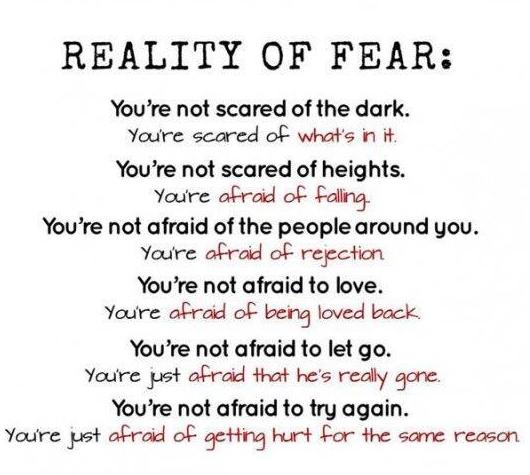
So why do we do that? Why do we expect that people should just push their fears to the back of their minds and not appreciate the reality those fears hold? There is a reason humans have a fear response in the first place. Our bodies and minds are wired to fear certain things in an effort to keep us safe – to elicit the fight or flight response. Without fear, we would be more likely to do things that put us in imminent danger. And yet, when it is a psychological fear and not a physical one, we are less likely to count it as helpful. Having a “healthy fear” of strangers and hot stoves makes sense to us But having a fear of rejection or being unloveable is not held in the same regard. Does that fear not serve the same purpose? To protect our mental health and ensure we are safe emotionally?
As a teacher, I am often asked to help troubleshoot student behaviour. I go into other classes and work with teachers to help students succeed. When we are deconstructing a behaviour, there is one question which needs to be answered: What is the purpose of the behaviour? What need is being met (or trying to be met) with this behaviour?
The same can be true for fear. If we get to the root of what we are actually scared of, oftentimes it might be easier to work through it. Is it a magic key that makes it easy to face? Absolutely not. In fact, often time understanding what we are truly fearful of is more upsetting and harder to work through. Because we are peeling away our own layers and doing the inner work to see what motivates us and what we run from. And most times these are direct results of past trauma and/or experiences which are not ideal to revisit.
I told a friend recently that they cannot allow the fear of an outcome to rule their decisions because it will lead to complete avoidance – which inevitably leads to the outcome you are fearful of. The one thing we cannot do is allow fear to take over our lives – to dictate what we can and cannot do. Closing our eyes and pretending it isn’t even there, that it isn’t real, is not realistic either. There has to be a happy medium where we can acknowledge the fears we have and use them to motivate us. Understanding that fear has both a birthplace and a purpose in our heads is the first step. Being willing to discuss them with those closest to us is the next. Allowing the space for those fears, but not allowing them to own us. Sounds super easy, right? Except it’s not. It takes time… lots and lots of time. It takes appreciating the purpose, not ignoring it, and yet giving ourselves the grace to work through it. Which is something I am still working through it.
Giving myself grace is a different beast altogether. I will consider this a work in progress.
We all do it… sometimes weekly…. usually daily… the mindless social media scroll. Our time to unplug without expectations or responsibilities. A safe, easy way to disconnect from our responsibilities and check in with those we know, and often times those we don’t. Except it is never that easy or safe. In fact, if we are not careful, it may be the most detrimental thing we do all day.
“Social media was a place for witty, satirical comments; stylistic food pics; photos of beautiful homes and children; and birth announcements. It was a place to scroll through to get an idea of where you fared in the world, and figure out whether you were winning or losing at life.”
The Family Next Door, Sally Hepworth
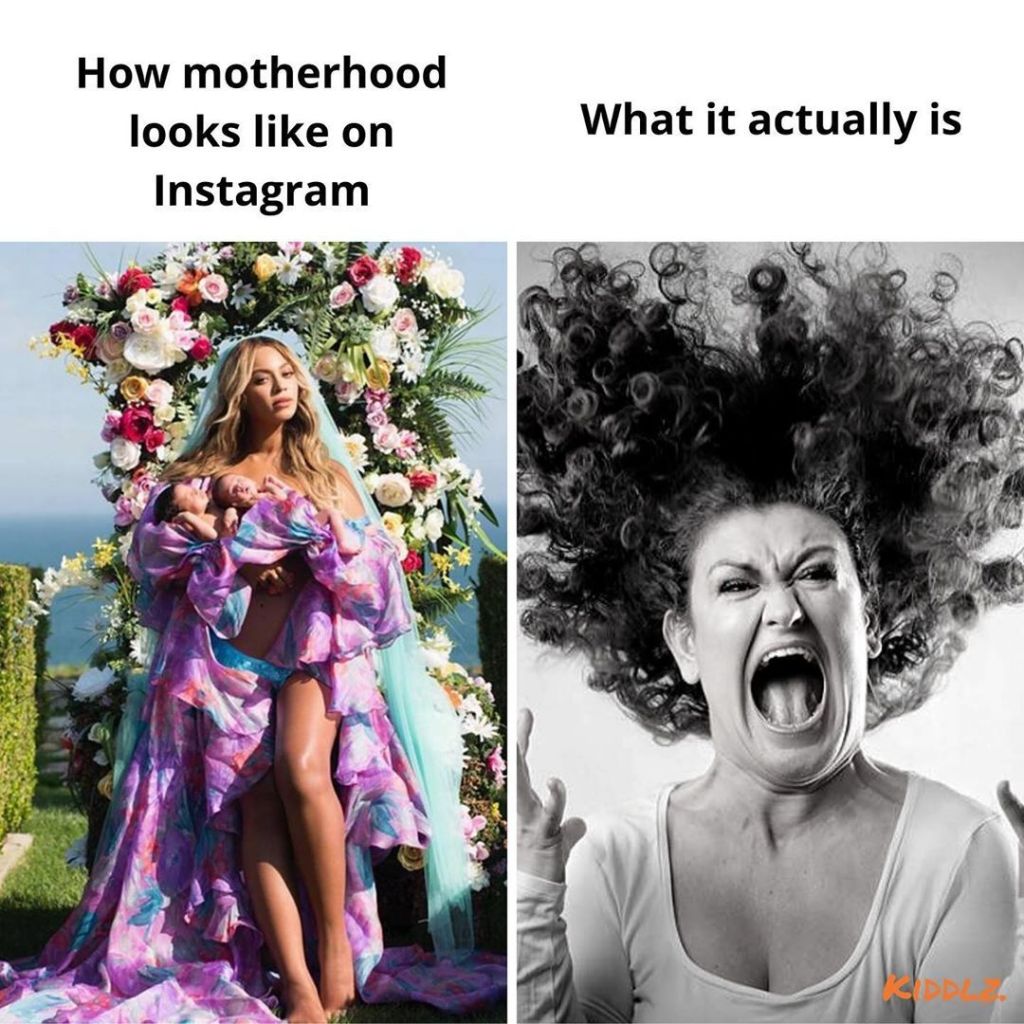
Social media is a funny thing. We approach it as though it is an open door into people’s entire lives instead of a small window. We view, judge, and envy them based on what they post in little squares. I am guilty of this, as well. Getting caught up in what people post about themselves is so easy. Their accomplishments, their vacations, their bright and shiny lives. We see all the things they want to share and all the ways they want to show their lives to others.
In the past, I have done the same on my own accounts. We want to showcase all the good things and memorialize them in the social media squares we post. We want others to see the good things about our lives. Those are the things we are comfortable sharing. There is no danger in that. And the truth is, as consumers of social media, I doubt the escape would be as fulfilling if our feeds were filled with negative or difficult topics. The state of the world right now is one of the reasons we turn to social media to “tune out” the noise – to go and see fun, light, uplifting content.
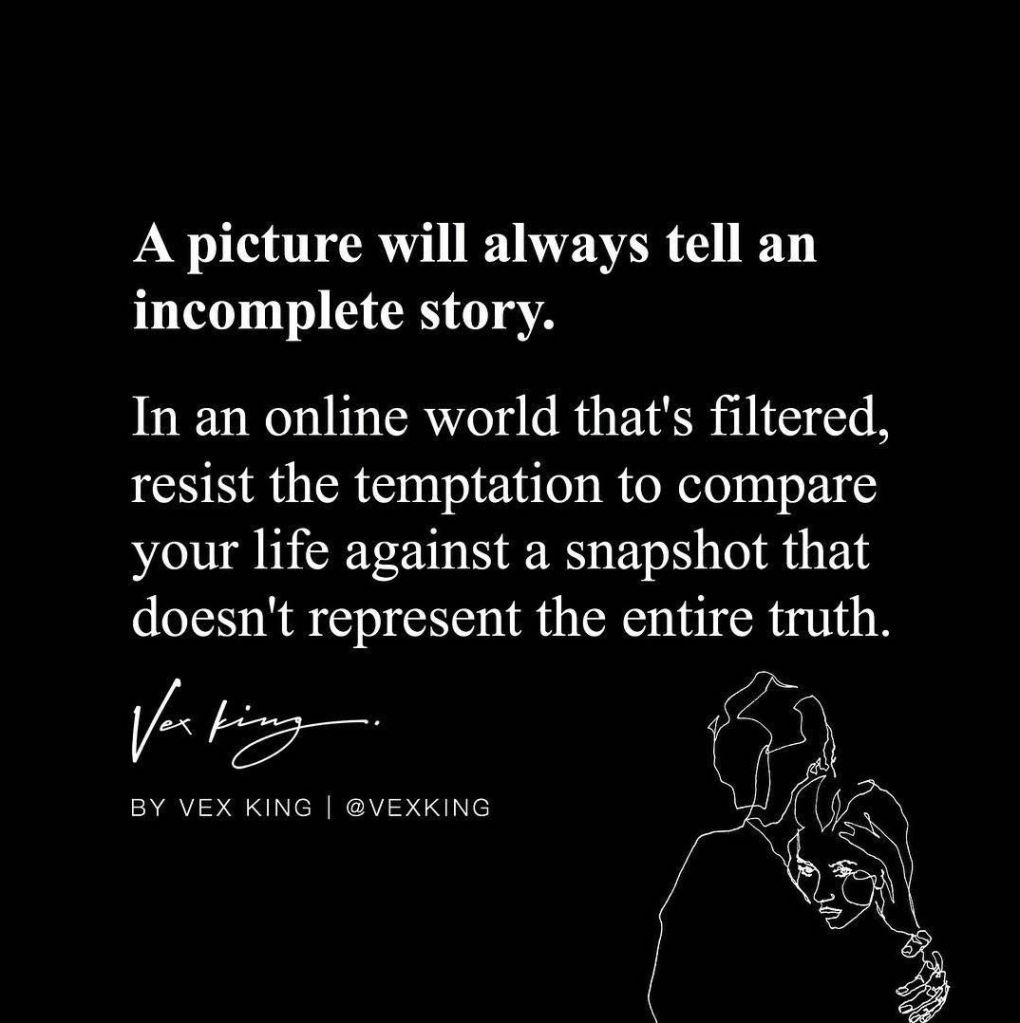
Very few people want to air their grievances, dirty laundry, or hard days for the entire internet to see – and with good reason. There is no reason to invite people into every aspect of our lives and let them know all our struggles. There is no reason to post about the fight we had with our spouse about taking the garbage out or the way it takes double the allotted amount of time to leave the house in the morning. These are private moments that aren’t meant to see the light of day. They are events that are meant to be sorted out in private without a show to the world. However, when we intentionally leave those out of the equation, we present a filtered view of our lives. We present only half of the story.
This is not to say that I think that everyone should post everything about their lives. Some things SHOULD remain private, and not open to the world. We do not have a responsibility to anyone other than ourselves. The purpose is not to share the ins and outs of everything that you do every day. We are not animals in social media cages for everyone else to ogle and point at. I have always wondered this about influencers, who often post so many aspects of their daily lives.
There is a point at which posting about everything leaves little room to actually live your life. We have to be okay to live outside of the camera instead of through it. In an effort to video and photograph our moments and lives, we forget to truly live through them. This is not healthy either, nor does it set a good example for our children.
However, I think that there needs to be a medium, both for creators and consumers of social media. Over the past couple of years, I have tried to be more candid about the struggles I am facing. I have used this blog as a vehicle to share many of those deeper, more honest thoughts. I have also tried to share more on my social media to present more. of a whole picture. There are still things I keep very private and have no interest in sharing with others. If you are in my inner circle, you are privy to that information, but it is not out for the world to see. And that is how I believe it should be. There is also still an element of fear about being judged by others that I m working through. This will never change, but I am beginning with being more open and honest with myself, and I am hopeful that the rest will come. It won’t ever change completely, but perhaps there will be a shift in that direction.
As a consumer, it is more difficult in many ways. Understanding that people only post certain elements of their lives is easy to digest when you are in the mindset to do so. When you are in a positive headspace you can see social media for what it is – a snapshot into others’ lives covered in pretty filters and hashtags. It is a collection of what others want us to see. However, when you are feeling down, doubtful, or anxious, it is more difficult to see it for what it is.
We view it with green eyes and self-doubt. Why are they happy? How do they have everything together? Why are their children so perfect? How can I have what they have? We quickly forget that there is so much going on behind the scenes that aren’t shared because we are already feeling down on ourselves.
I have had numerous conversations about this with my therapist, and how not to fall into that trap. She gave me the best advice on the matter – use the mute button. If they are not serving you, shelf them for a bit. It doesn’t mean that you have to delete those accounts indefinitely, but giving yourself a break from those who are not welcome in your season of life is liberating. I have been trying to change my algorithm by following and interacting with accounts that fill my bucket and my soul. Accounts that are more real, geared towards self-care and daily quotes that fuel my soul. I have also significantly decreased my time on social media in total. I know my sister goes as far as to put a 30-minute timer filter on her phone so it only lets her go on social media for a small period of time per day. She never comes close to that time, but even knowing it’s there is enough for her.
I think, above all, I must close with this: like many topics in this blog, I write about things I am nowhere near perfect at. I share my thoughts because they are relevant to me, and I believe that opening the discussion is the best place to start. I do not share to be preachy or because I have everything together. This is so far from the case. I am struggling with this every day. So let’s try to normalize that what we see and show in our squares is only a piece of the puzzle. It is the view we want to give others. And there is nothing wrong with that AS LONG AS we take it for what it is – a filtered view of reality.
**TRIGGER WARNING: This post contains material of a graphic and controversial nature**
I am angry, upset, and speechless. This past week, a historical error was made in the United States supreme court. It took me time before I could even prepare to write this. I had to let the information sit with me, and mull it over for a while. This is the first time in a long time that I needed to formulate my thoughts before I could even begin to put them down on “paper”.
Let me start by discussing Roe vs. Wade, and why it is important. In 1973 the United States supreme court voted against the banning of abortions in Texas, which in turn made abortions legal across the country. It maintained that it was a woman’s constitutional right to her body and decisions surrounding it. Up until that point, women could seek abortions for medical reasons, or travel out of the country if they had the financial means to do so. Those who were impoverished or did not have access to proper medical care sought out illegal clinics or, unfortunately, took matters into their own hands. The decision in 1973 allowed women to access abortions safely when necessary. It is also critical to add that constitutional law overrides state law, so states that wanted to ban or limit abortions no longer had the power to do so.
After the ruling, women were able to make choices about their bodies based on their circumstances. This segued into birth control, health care, body and sexual autonomy. It would appear it was only about one issue, but in fact, so much more came of it. Crime rates, incidents of illegal abortions, and risk of death were all lowered. Employment and healthcare opportunities increased. By normalizing a woman’s right to choose, confidence increased. And yet, this week we were shuttled back 50 years when the court overturned the decision. Before we go any further, an important distinction needs to be made. Being pro-choice is not the same as being pro- or anti-abortion. Pro-choice means you are open to the right to choose. It doesn’t mean you have to agree with her choice. Pro-choice means that you believe that legislation and government should not dictate a woman’s body. And yet, here we are… stripping women of their right to choose what they want to do with their own bodies.
Being pregnant and choosing not to be is not limited to women in committed relationships (although even then it is within a woman’s right to choose). Being pregnant as a result of rape, ectopic pregnancies, or pregnancies with fetal abnormalities are all reasons why women may choose to end the pregnancy. This doesn’t even mention medical or economic conditions which may come into play. I am not sure what upsets me more – the fact that this decision has been overturned or the number of times I have read comments on social media that if you don’t want to be pregnant, you should “just close your legs”. The shame that is placed on women for even being in the position to need to make a choice is its own version of cruel and unusual punishment.
I WISH I was making this up because my faith in humanity drops down a point each time I read a comment like that. It is such a close-minded, myopic, uneducated point of view, which is almost always held by those who have never been put in the position to make that choice.
All that is to say that there is a sense that when a woman chooses abortion it is a flippant decision, which is not necessarily the case. I want to qualify this by saying that I have never personally been in this position but I know others who have. Many women wrestle with the decision and do not come to it lightly. It is one that is made over the course of many days of debates and even more days of questioning after the fact. Women who choose to participate in abortions live with that decision every day – it is one they don’t forget.
The overturning of this decision is about the right to choose, yes. But it is also about power, autonomy, voicelessness, the lack of rights for women, and the even smaller rights for those who are marginalized and impoverished. Yet again, those who have access to money and means will go to another state or another country to safely access abortions. Those who cannot, will be back to illegal clinics and underground means.
For a country that is already grappling with the right to bear arms, and the rampant gun violence that is plaguing communities, it is a sad fact that women seem to have fewer rights than guns. Guns are protected – if you want them you can have them. Women, not as much.
As a mother to a girl, I am sad. Even as I sit here and write this, I think about my own daughter. I am aware that I am writing this in Canada, and I technically don’t have to fear repercussions should she or I ever be forced to make a decision like this. I am grateful that the Canadian government has come out and stated that women’s rights are sacred and will never be up for debate. I am grateful that our country is one that has pledged not to politicize a woman’s reproductive system. But I would be remiss if I didn’t say I am still scared. I read a quote last week that said that “when the United States sneezes, Canada catches a cold”. While I don’t think the same law will come into effect here, our neighbours to the south do influence us. What does it say about the United States that 9 people have been able to make a decision affecting millions? Their morals, beliefs and laws are all, at some point, intertwined with ours. What does it say about us as humanity if the country that is considered one of the most progressive in the worst has sent women back to the dark ages? American children will have fewer rights than their mothers did. This will very sadly have global implications with other countries feeling more empowered to limit women’s reproductive rights.
Interestingly enough, my daughter approached me as I was writing this and asked what I was writing about. I told her I didn’t want her to read it, and that I needed time to explain it to her. And I sit here wondering how I can even begin to verbalize this to her. Not because it is about sex and pregnancy but because it is the opposite of everything I have taught her about her body. I have always been very clear that it is her body, and she has every right to make decisions around it… and yet some people think that shouldn’t be the case. How do I explain to her that if she ever got pregnant and chose not to keep it that she could exercise her right to choose, but so many women have just had that right taken away? And on top of it all how do I begin t explain that there is nothing we can do to change it? Yes, we can donate to organizations, sign petitions and make our voices heard, but at the end of the day, the decision is not ours to make. This is a heavy pill to swallow.
So I sit here, mad and angry. And the truth is, you should be angry, too. It doesn’t matter if you are a woman, a man, a Canadian, an American, someone who is out of child-bearing age, someone who doesn’t want children…. everyone should care. You should care about your mothers, sisters, and friends who are heartbroken by this silencing of their voices. You should care about the fact that women are feeling alone and abandoned. I am heartbroken that this is even a topic of discussion. I am devastated that there are so many women in a FIRST WORLD country that no longer have the autonomy to choose what to do with their bodies. I am enraged that the shame associated with rape and incest is magnified by the legality of the potential additional decision of terminating a resulting pregnancy. I feel helpless about the current state of humanity. Currently in search of an unknown silver lining…
So it’s been a minute since I’ve written. When I started this blog I had grand ideas about publishing once a week. It’s not that I don’t have enough to say, it’s that putting it down on paper has proven to be a trying task. There are times my mind feels like a washing machine, and all my thoughts are articles of clothing. They all mix together, unsorted, trying to get clean and organized. But instead, they just roll around in my head. Life has definitely gotten in the way and I have had to pause to take some time for myself. Taking care of my mental health is definitely harder to put into practice than just talking about it. It’s something I am a huge proponent of, and have written about before. However, as is always in life, talking about something and putting it into practice are two very different beasts. But… to be the best mother and woman I can be, I have to be a little bit selfish.
Over the past little while. I have found myself having many conversations with people about therapy. It has made its way in countless times, not intentionally, but simply in the course of conversation. I have never been shy about speaking to a therapist, and I gladly share my experiences with others. I am a huge champion of therapy and the importance of both talk therapy and behaviour management skills (in the form of CBT and the like). I think this comes from my background in psychology, but also in seeing the results firsthand.
I remember one time in the car, J had asked me about a therapy appointment. She wanted to know why I was seeing a therapist, In hindsight she actually got the terms therapist and chiropractor mixed up (ha!) but I didn’t know that at the time. I took the opportunity to explain to her how important therapy is and how wonderful it is for adults to seek support. I explained to her that just like kids need someone to talk to and problem-solve, adults need the same.
It doesn’t go away just because you get older, even though children (and truth-be-told many adults) think it does. I told her that the strongest people in the world need therapy. And I truly meant it. I never want that therapy to be a bad word.
All of this is why I’m here to say that therapy is one of the best forms of self-care. Far as someone who is perpetually anxious, talking through scenarios and potential issues is a great way to self-soothe. Even more so, using those opportunities to do inner work, speak to my inner self, and revisit previous traumas are all great ways to grow personally and psychologically. These are all things that cannot be accessed when we are in immediate crisis because they are less important at the time. However, they are just as important during growth periods.
In the past, therapy has been viewed as something crazy people needed to do to get well, or that addicts needed to do in order to recover. It was mandated… necessary to become a better, more functioning member of society. But the truth is, we are complex beings. A lot is going on in our minds and the ability to resonate with our thoughts and be the strongest we can be mentally is so important.
Being strong enough to say that we are working on ourselves is one of the best forms of self-care. Taking the time to be the best we can be, or even bitch and complain to an impartial party will allow us important clarity.
One thing that I am working on is consistent appointments with my therapist, whether I am in crisis or not. Consistent doesn’t need to be weekly, but just at a regular interval. Although I am not ashamed to admit that my weekly therapy appointment is often the highlight of my week. I think that in many ways continuing therapy during those “downtimes” can be more powerful than when we feel we are in desperate need to speak to someone. I am guilty of this in a huge way. I let my therapy appointments lapse because I felt like I was in a good place. Then, the moment I felt like I was in crisis I was incredulous at the fact that my therapist couldn’t possibly drop everything and see me immediately. This is obviously completely unrealistic and a sure sign that I was in desperate need of therapy. But obviously, this is not the way the world works. And therapists don’t sit around like a crisis hotline waiting for you to meet them.
It should be said, though, that although I am saying this with a bit of jest, there IS a crisis hotline should it be needed, and there is no shame in accessing it. In Canada, the Suicide Prevention Hotline is available at 1-833-456-4566. In Toronto (where I am based out-of) you can always call 905-408-HELP 24 hours/day. If you are EVER worried that you or someone close to you are in imminent danger of self-harm, please call 911.
This is life (and we don’t ever have to go through it alone). Love, Mom.
I remember as a kid singing this Sharon, Lois, and Bram song over and over. At the time, this song about slowly going crazy and losing your mind was on repeat in my house. Not because I felt crazy but because it was fun to laugh about losing your mind. Oh, to be a child of the 80s again…
Somewhere along the line, something switched. It wasn’t that I moved from counting forwards to backwards as the song goes, but more so that my mindset changed. As an adult in an environment where talking about mental health is more common, the idea of slowly going crazy has taken on a brand new meaning. I know there are times when we all feel like we’re a little crazy. The word itself is fraught with negative connotations. Being called crazy implies a lack of control, and an inability to regulate. And yet, there is this incredible juxtaposition happening. It has become more socially acceptable to talk about your feelings and inability to cope 100% of the time. More and more, we see campaigns, social media posts, and books all about self-care and the importance of mental health. I am grateful for the increasing openness around this topic. When we think of mental health struggles, we think less about a person chained in a psych ward and more about a regular human.
I am here to continue the discussion and be as open and honest about my own struggles, in hopes that it opens the door for someone else. I have always been somewhat of an anxious person, striving for perfection academically. I don’t know whether I was able to manage it better when I was younger or the stressors were simply smaller, but it was never really an issue. It was just a way of life. As an adult, and more so as a mother, I felt my anxiety spin further out of control. Again, I felt that I was able to manage it. Maybe I was, or maybe I wasn’t. I will never know if it wasn’t as difficult for me or it was less socially acceptable to discuss. What I do know, is I was definitely not as aware of the importance of my mental health as I am now.
The irony of all this, of course, is that my own undergraduate degree is in psychology. I loved learning about how the brain works in the university and in particular adored my abnormal psychology classes. At one time thinking I might pursue a career in school psychology, how the brain works fascinated me. How we deal with trauma, conflict, and aversion was my main focus in school. But there is there a reason they say doctors make the worst patients. Not to say that I am a doctor, but the analogy still rings true.
I have a distinct memory of a few years back when I knew I was out of control. I can feel it like it was yesterday, although I couldn’t tell you the specific dates. I can close my eyes and I am back in that place. I had been experiencing panic attacks, and for the most part, I was able to keep it to myself. I knew that something wasn’t right but I tried to power through it. One day, I was driving and had a panic attack so severe I had to pull over. It scared me because it was the first time I felt truly out of control. I was by myself in the car but could only think about what might happen if I wasn’t. I sat in the parking lot as my hands and feet tingled from my shallow breathing and knew I needed help. I went to see my doctor the next day and a combination of medications and therapy ensued. Neither could work independently, they needed to work in tandem with one another.
Today things are better but I am most certainly a work in progress. If I can take anything from this journey, it is that it is a marathon not a sprint… but all without a finish line. I have days where I feel incredibly in control. I feel like a superhero who can handle anything thrown at me. Other days, I feel triggered by the smallest thing. I can feel the tightness in my chest and the clenching of my fists.
Having a support system, as cliche as it sounds, is integral. There is something very normalizing and reassuring about being open about your struggles. Our failsafe is to reject what we don’t understand or make us uncomfortable, or to humourize it. Even now I often refer to my medication as my “anti-crazy pills”. I know that isn’t what they are, but for some reason making light of the situation makes it feel more manageable.
And this is what I have come to terms with – the new normal. It the normal that things don’t have to be perfect. The normal that mental health needs to take priority. The normal that needing help and asking for it doesn’t make you weak – it actually makes you stronger. And the normal that keeping things inside is as unhealthy as any other physical ailment.
About two months ago, I began a journey to become a certified yoga teacher. Yoga has been a part of my life for more than 10 years. When I was pregnant with J, yoga was one of the only forms of movement I could tolerate. When Covid hit, J and I would do yoga together in the evenings to wind down. Although it eventually lost its appeal for her, I ramped up my own practice. I enjoy the peace and calm it brings me amidst the chaos. So when my best friend told me that she was going to work towards her certification, it appealed to me. We decided to do it together, as best friends do. I knew I loved the poses and active movement involved, so why not learn more about the history and origins?
What I didn’t realize is just how much the breathwork and meditation components would mean to me. Mindfulness is such an important part of good mental health, as is an awareness of one’s self. I love that you don’t need tools for the breathwork – it is the most portable form of self-care. Many people are intimidated by the quiet and metered breathing. There is a misconception that it is time-consuming and you must sit in silence for an extended period of time.
So for my first yoga-inspired post, I wanted to share the ways that I incorporate breathing and mindfulness in my day, to show that it can be easier than you think. Breathing is something we need to do. Our bodies manage it without us thinking about it. But when we are stressed, anxious or tired our breathing innately becomes more shallow. Scientifically this is because our body stops relying on the diaphragm to breathe. In yoga, the prana (or life force) is brought into the body with our breath. Being aware of it and harnessing it is a huge source of power and strength. I am here to share with you some of the ways I am mindful and practice “pranayama” (Sanskrit for the regulation of breathing) in a real-life go-go-go setting.
ONE: Be present. This doesn’t mean you have to be present at every moment of the day. One of the biggest yoga gurus, Richard Rosen, talks about taking in the small moments of the day. We don’t do anything specific, but instead, do nothing and just observe. I find when I am taking the dog for a walk in the morning, or sitting in my car at a red light, I take 30-60 seconds and become very aware of the moment. I really take in all my senses – what do I hear? Smell? See? Just taking that time to come out of my head and into the moment can be very powerful. Think of it as a quick mental reset.
TWO: Take deep breaths. I find when I’m stressed (and let’s be honest, that is often!) practicing equal-part breath helps me to focus. Equal-part breath is one of the core breathing techniques in yoga and it is easy to access. If you find it helpful and safe, you can close your eyes. I typically do this while I’m driving and the kids are yelling at each other, so my eyes would NOT be closed. Empty your breath, and breathe in slowly for a count of 3-4, depending on what you can do. Then exhale for the same amount of time. If this is difficult you can try just inhaling slowly and exhaling your normal breath. But, ideally, you are focusing on breathing in and out equally (hence equal-part breathing). The focus becomes your breath and not whatever is stressing you out. Again, this doesn’t have to be something you do for 30 minutes. Even a few rounds of breathing can be calming.
THREE: Take five. When we think of meditation, we think of a quiet mind without any distractions. We think of a group of people sitting in a room, with eyes closed and all humming in unison. In reality, meditation is what you make of it. When you are feeling overwhelmed, try this. Just sit down (on the floor, at your desk, on your bed) and listen. Instead of trying to turn everything off around you, just sit and experience it. Listen to the sounds around you instead of trying to tune them out. Are people talking? Birds chirping? A car horn blaring? Feel your body instead of trying to ignore it. Is your skin hot or cool? Is your stomach grumbling? Then focus on your breath… not trying to control it, but just listening and feeling how it moves. Even five minutes of this can be transformative.
My hope after reading this is that you can see that mindful breathing is much more accessible than we fear it is. There is indeed an entire practice dedicated to learning to meditate and breathe more successfully – but that is just it – it’s a PRACTICE. In our crazy busy lives, even taking five minutes to be present in our bodies and minds can be helpful. And at the end of the day, five minutes is better than nothing!
Pandemic life has been hard on everyone. It doesn’t matter if you are single, in a relationship, a parent, working from home, working remotely, or unemployed. We have all had our own journeys to go through. This pandemic will be taught in school for years to come – that our kids will talk about with their kids. For many, this has been one of the hardest seasons to get through, for a variety of reasons. Access to daily necessities have been increasingly difficult (umm hello toilet-paper-gate 2021??) and life as we know it, has changed. We will all be masked for the near future, and stock for Purell will continue to rise. Exercise and access to physical fitness were one of the areas of our lives that took a hit. Depending on your mindset and mental state, this could have been either a positive or negative change.
This love story began in February 2021 when our bike came. Actually… it started earlier when Hubbysuggested a Peloton and I scoffed at how expensive it was. He talked about this bike that he had heard of – that there were on-demand rides and you could spin with other people. I loved the idea but couldn’t understand why it was necessary. At the time, I had been the equivalent of a couch-hermit, not participating in very much activity. Prior to Covid, I was doing kickboxing workouts 4-5 times a week and was in the best shape I had been in years. I felt good both physically and mentally. But then, we went into viral lockdown and everything diminished for me. So, the idea that we could park something in our basement and access workouts on demand was definitely appealing, but daunting.
A simple Google search will tell you that this all makes sense. You can read article after article that explains the positive correlation between exercise and positive mental health. Experts all agree that movement is paramount to improving mental outlook. It reduces stress, improves cortisol, creates endorphins, and lowers blood pressure. However, it is NOT magic. It is not a switch that you can easily flip and rainbows will form overhead. For those who struggle to get out of dark places, it is hard to get going. I remember having numerous conversations with both Hubby and my mother about feeling stuck in a cycle. I felt so tired, and I knew that if I incorporated exercise I would feel better, but I felt too exhausted to even start. My brain and my body were not in sync. Even though I knew what might help me, I couldn’t bring myself to do it. I feel so fortunate for my amazing support network, who listened, and encouraged, and helped me dig myself out.
I started my first ride a few days after the bike was delivered. I had no idea what I was getting myself into. I did a 20-minute Tabata ride without a true understanding of what that actually meant, and quite literally felt like I had died. I couldn’t make it up the stairs and Hubby couldn’t understand why I started that way (in hindsight I have no idea either!). But I decided to go back the next day, and the day after that. I hadn’t realized initially that Peloton was not just spinning. I love that I have access to other classes, too. When I started feeling very sore, I began adding yoga routines in the evening. It’s even gotten so that I can’t fall asleep properly if I haven’t done even a small yoga class.
What I didn’t understand then, that I do now, is there is no price tag too expensive for your mental health. feel so much stronger both mentally and physically after 6 months. It’s a change in mindset and an embracing of my positive energy. It’s putting myself first for 20-30 mins a day and ensuring the endorphins carry me through. I love that my children can watch me on the bike (with headphones for those explicit classes, ha!) and see the importance of moving your body. When I was set to hit 100 rides, they were so excited, and it was so amazing to see. More so than the signs they made or the fact that they were cheering me on, was the fact that they were able to see that this milestone was a big deal. I want to be able to instill those healthy habits in them.
So now I am working towards my next 100 rides, my next 100 strength classes, and my next 100 yoga classes. It won’t happen overnight but I am confident that I am going to keep at this. It isn’t just for myself anymore. I want to show my kids that not giving up working towards a goal and putting yourself first all make you stronger. It makes me a better mother, a better wife, and a more sane human. Cheers to the next 100!
This is life. Love, Mom.
A small disclaimer: I do want to take a moment to say that I am well aware of the privilege that goes along with this post. I know that machines like this are not accessible for everyone. I feel so very fortunate to be able to not only write about this but access it daily. I want to add that there are many machines and apps that are less of a financial commitment and can be game-changers. This is what worked for me, and I am so happy to share that it has.
A couple of weeks ago, I went out with two girlfriends who are also teachers. So, of course, at one point the conversation inevitably turned to the profession. The gist of the conversation, and how heated we got when we talked, is what influenced this post.
Let me start by saying that every job has its ups and downs. Every profession has positive elements and those that are less desirable. And, at one point or another, we have all complained about our jobs. Teachers, however, have somehow earned the medal of “top complainers”. The general consensus is that teachers have nothing to complain about. Summers off, short hours, good pay, and benefits, a bull of a union…. what do we have to be upset about? If that is the case, why are teachers taking more than fifty percent more sick days than a decade ago? Why have mental health leaves skyrocketed? And why is teacher burnout a such common conversation nowadays?
Teachers used to just teach. I don’t know about you, but when we were in school, the teacher stood at the front of the class, taught a lesson, and then assigned follow-up work – questions from a textbook, a worksheet, or something similar. I remember the thirty minutes of DEAR (Drop Everything And Read) time every morning.
My music teacher used to play his accordion at the front of the class while we sat at our desks and sang along. I can still hear the sound of the AV cart rolling down the hall so we could watch Bill Nye videos for science. Granted, as kids, we didn’t have a good understanding of what the teacher did after hours (I mean, who didn’t think their teacher slept at the school?). I’m not saying teachers didn’t work hard, because I am sure they did, but the expectations were much different than they are today.
The curriculum of today looks very different than it did a decade ago. The expectations are more rigorous and robust. This provides a much more enriching curriculum for students. However, since there is so much to cover, the understanding is that everything must have a purpose, and be tied into the curriculum. The days of DEAR are gone. Often teachers are told that if there is no follow-up or assessment component, it can’t be done. Reading for the love of it or watching a video to enjoy the content isn’t enough anymore. There must be a specific, curriculum-driven purpose to everything. Now, I don’t necessarily disagree with the thinking behind this. I think that if you cannot justify why you are filling your time with a particular lesson, it may not have a place in the day. Equally, just as in any profession, there are teachers who, if not monitored, would otherwise take advantage of this. And the truth is, with so much curriculum to cover there is very little wiggle room in the day to begin with. But in an effort to enrich the day, we run the risk of removing the love of learning and exploring. For example, there is a true benefit to reading for enjoyment, without worrying that you are going to be assessed on what you are doing. Sadly many students wouldn’t otherwise pick up a book if it was not during school hours. Teachers have very little leeway to exercise these options. Which is all to assume that they understand the options in front of them. Teachers college is fraught with hypotheticals, academic articles and educational history. The academic nature of the programs puts teachers at a huge disservice. When I completed my degree I had three years of once-a-week practicum, and I definitely wasn’t prepared. Teachers now have even less. There is not enough real-world experience to adequately prepare new teachers for their roles.
If that was all, the job would already be stressful. However, this is only part of the equation. As a teacher today, delivering curriculum is only a component of your job. You are also a social worker, tech support personnel, therapist, confidant, substitute parent and parenting advisor. You can even, at times be a marriage counsellor, verbal punching bag, psychologist, or suicide support interventionist. You have not been trained to do any of these jobs properly, but are expected to put any of those hats on at a moment’s notice (and sometimes more than one simultaneously). Nothing in the system prepares teachers for those roles. Some professionals go to school for years to do these jobs properly. However, in our tapped system they are only available infrequently, and rarely at the moment when they are needed most. Most training and professional development are done during monthly staff meetings, or on teachers’ own time. Courses and training are often offered on a voluntary basis for teachers to complete on their own. The argument from society is that it is part of the job and teachers just have to do it. The argument from the teachers union is it isn’t part of the job and teachers have to say no. Neither one is feasible and there is very little middle ground. Teachers are so many things to so many people. It is rewarding but exhausting.
Many teachers take their jobs home with them both emotionally and physically. Yes, teachers are allocated a certain amount of prep time in the day, but that is often used to prepare engaging lessons, soothe a student, handle a social disagreement from recess, or phone a parent. Paperwork, report cards (at a time cost of over an hour per student), marking, timely assessment and feedback, and planning are all often taken home in the evening in an effort to catch up.
None of this is part of the workday. And yes, I am well aware that other professions work after hours. This is a typical counter-argument to teacher concerns. However, they are typically paid for their overtime or paid per project. Granted there are other professions where work is taken home to be completed without overtime, but just because others do it doesn’t make it okay for anyone.
Taking all of this into account, of course there would be burnout. It only makes sense that all the pressure would become too much for some. I myself fell victim to the pressure pre-covid. A few years ago, I was presented with a class that was like no other. Individually they required inordinate support, much more than I could provide them as one person. Together, their personalities did not mix well. A CYW (child and youth worker) was placed in my classroom for daily support. Together we created a multitude of social skills lessons, which unfortunately did very little to support the class. I felt like an octopus, trying to put out multiple fires at the same time. This was all before I even attempted the curriculum (which many days went right out the window). I began having panic attacks before the students even walked in the door. I would sit in my vice principal’s office and cry out of sheer frustration. I became anxious at school and home. The work-life balance was obliterated. My diminished mental health made it impossible for me to do my job as a teacher AND as a mother. So with the help of my admin and my doctor, I made the decision to take a stress leave. My steps to protect my mental health was the best decision I could have made. It was also the beginning of my journey of self-care advocacy for myself and others.
I share this because I am a seasoned teacher. I would like to think that I can take most of what the profession throws at me. But at a point in time, it was all too much for me to handle. In the spirit of transparency, even as I reread this post to review it before publishing, I feel tears in my eyes. The stress and toll can, at times, be too much. New teachers who don’t have the experience, and older teachers who have difficulty adapting to the changing landscape of the system are even more at risk. There is real merit to teachers asking for help…. to advocating for more support. Teachers are crying out for more support for their students, their classrooms, and themselves. The system is not build to adequately accomplish this. There is not enough money, time, or hours in the day. There is no easy answer here. It is a systemic issue that will not be fixed overnight.
This post is not meant to be a “woe is me” rant. It isn’t meant to have others feel sorry for teachers. I am sharing this for those who believe that teachers simply deliver the curriculum, go home at night with a glass of wine, and then enjoy summers off. I am sharing for those who believe that all teachers do is complain, and have no merit to do so. This is especially important as we are set to enter another unprecedented year in the education system. So next time you feel yourself judging a teacher for having the summers off, having an “easy” job, or for complaining too much, I urge you to take a second to think that through.













 Life Love Mom