As cliche as it sounds, there is nothing harder, yet more fulfilling than being a parent. There are so many times I pinch myself, wondering who gave me the responsibility of raising children. Not that I’m not capable, but to some extent we were children, and now we are responsible for our own children. So many parents lament “if only there were a handbook…..” or wonder if they can google “how to raise my kids”. It can be hard to find yourself in the ebb and flow of parenting. Not to mention, what is good for one child is rarely the same for the next. There needs to be a balance between being the “helicopter” parent and letting our children just figure things out on their own. Neither at its extreme is helpful or rational, but it isn’t easy to find that middle ground. There is nothing we want more than to keep our kids safe, and to have them become good humans…. but how we get there is a bit of a mystery. We know the final destination, but the roadmap is nowhere to be found.
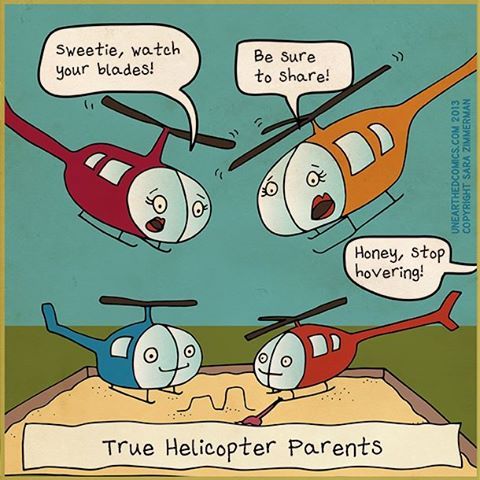
No one would argue that being a helicopter parent is a good idea, for both the parent and the child. In case you are not familiar with this term, a helicopter parent does not let their child out of their sight. The constant micromanaging, worrying, hovering over your child, and keeping them close is not ideal. The fear is that they will be hurt, or put in a dangerous situation. So the antidote is to ensure that you are constantly there to protect them. However, in doing so it leaves little room to allow them to make mistakes.
It also makes transitions to school and programs quite difficult (usually more so for the parent than the child). As much as we want, we cannot go through life holding their hands, or encasing them in bubble wrap.
And to be clear, the opposite is no better. The idea that children should simply learn by experiencing life, and from their mistakes is fraught with issues, as well. Yes, children should learn life lessons, and get the bumps and scrapes that come with growing up. As a teacher, I can appreciate that learning certain skills on your own is much more valuable than having them explained to you. Coming to understand the world through natural consequences is indeed important. Working through experiences, building resilience, and figuring out right from wrong are all invaluable lessons. But, by being completely hands-off, children lose the attachment to parental figures that is so important. And the question is – are we putting them in unnecessary situations? Are they learning lessons they shouldn’t need to learn? The argument becomes if we CAN protect them, why shouldn’t we?
With all this back and forth swirling around in our heads, and the whispers of every parenting expert in our ear, what is the answer? What path will yield the best result? All we know is we want our children to be the best they can be; to grow up to be good, self-sufficient, kind human beings. As mothers, there is an inherent fear that we are constantly messing up our kids. I myself am guilty of this, as well. Decisions are met with self-doubt, questioning, and rationalization. Should I have let them do their own thing? Did I not step up enough? Was the best decision made for the situation? These questions are coupled with the nagging notion that each decision holds more weight than it truly does. As if we are one decision away from permanently messing up our children. Of course, in hindsight, this is rarely the case, but it doesn’t feel like that at the time.
Interestingly, before I had children I often thought I would be more relaxed (I mean, didn’t we all??). I didn’t think I would be so worried all the time – specifically about the kids hurting themselves or becoming ill. And yet, here I am. I want them to be good, do good, and feel good. I want them to stand up for themselves and be respectful. I want them to be safe and secure. But I struggle with how best to execute this. I have had my “helicopter” moments, and let me tell you there are more of them than I’d really care to admit. The idea of them falling (either proverbially or physically) and not being there to catch them is daunting. I know that this feeling was heightened when J became very ill and was hospitalized at 2 years of age. I won’t get into it now, but I will in future posts. There is a delicate balance between keeping them safe and allowing them the opportunity to learn on their own, and admittedly I don’t know the formula.
So can you imagine what happens when you throw Covid into the mix? The mystery that has plagued communities for the better part of two years has sent us all into hyperdrive trying to protect our children. Teaching them to wear masks, sanitize their hands, sneeze into their elbows, and inform adults when the sniffles are “just allergies” (when they truly are, of course!) has taken over our lives. We are left with the question, how can we protect our children if we haven’t yet figured out how to protect ourselves? Yes, we are making headway, but there is still a ways to go. Now let’s be clear – I am not using this platform to delve into the vaccine or mask debate. There is too much there to unpack, and I don’t think a one-off blog post is a place to do it. But, of course, these are other questions that are constantly top-of-mind. The whole situation would send any sane parent into overdrive, wondering how best to ensure their child’s safety.
These are thoughts that continue to plague me, especially since September is already here. Maybe that’s part of the balance I struggle to find as a parent. What I DO know is that Covid has hit those who question their parenting, who don’t want to hover but cannot bear to look away… This is not to say that we have all had our own struggles because of this pandemic. But as we enter another school year, I know that the parents I talk to are all worried about the same thing – how can we keep them safe when we can’t see them all day? How do we keep them healthy when we have no control over the environment they are in? There is an element of letting go that is involved in sending our children off to school that is difficult to grasp – even for parents who are more hands-off than the rest.
If I’m being candid and honest, I’m not entirely sure what I want to impart in this post. I began writing this because I wanted to grapple with my babies returning to school, and the extra layer that Covid has added. Having been home last year altogether, sending them out into the world again is frightening. I want them to have the most normal of experience in what is the most abnormal of circumstances. All the while, I want to keep them safe. So when I find my helicopter, we can all jump in together and hover over our children. At least for the near future until we can see the light at the end of this very dark tunnel.
But this is life. Love, Mom
 Life Love Mom